




Blog
Standard Rug Sizes: Complete Rug Size Guide for Every Room

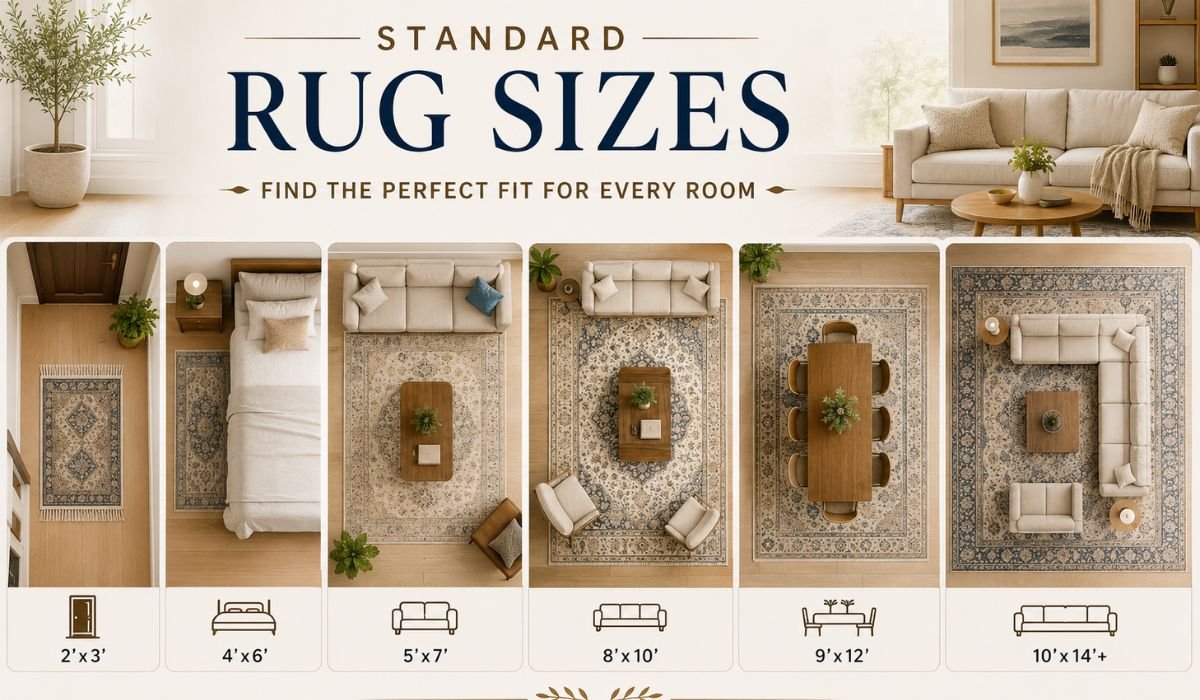
Choosing the right rug size can completely change how a room feels. The correct rug defines a seating area, visually connects your furniture, and can make a small room feel more open or a large room feel cozier and more finished. A rug that’s too small looks like an afterthought, floating awkwardly under a coffee table, while one that’s too large can overwhelm the space and cramp walkways. There isn’t a single “perfect” rug size for every home. The right dimensions depend on your room’s size, how your furniture is arranged, the amount of foot traffic the space gets, and how you plan to use the room day to day. That said, most homes fall back on a handful of standard rug sizes that work well across a wide range of layouts. This guide walks through those standard rug sizes room by room, so you can shop with confidence and measure with precision.
What Rug Size Do I Need?
Enter your room dimensions and furniture details to get a recommended standard rug size.
Common Rug Sizes at a Glance
| Rug Size | Approx. Size | Best For |
|---|---|---|
| 5 × 7 ft | 60 × 84 in | Small rooms, bedrooms, entryways |
| 6 × 9 ft | 72 × 108 in | Medium rooms, dining areas |
| 8 × 10 ft | 96 × 120 in | Living rooms, bedrooms, dining rooms |
| 9 × 12 ft | 108 × 144 in | Large living rooms and dining rooms |
| 10 × 14 ft | 120 × 168 in | Large/open-plan rooms |
These standard rug measurements are a helpful reference, not a hard rule. Two rooms with the same square footage can call for different rug sizes depending on how the furniture is arranged, where the doors and walkways fall, and how much floor you want left visible around the edges.
Rug Size Chart at a Glance
If you just want a quick comparison of common rug sizes, this chart groups rugs by category so you can scan for the right fit.
| Category | Common Sizes | Typical Use |
| Small rugs | 2×3, 3×5, 4×6 | Entryways, bedside, accent spots |
| Medium rugs | 5×7, 6×9 | Bedrooms, smaller living rooms |
| Large rugs | 8×10, 9×12 | Living rooms, dining rooms |
| Oversized rugs | 10×14 and larger | Open-plan or large living areas |
| Runner rugs | 2×5, 2×6, 2×8, 3×8+ | Hallways, kitchens, staircases |
| Round rugs | 4ft, 5ft, 6ft, 8ft, 10ft | Round tables, reading nooks, entryways |
Standard Rug Sizes for Living Rooms
Living room rugs anchor the seating area and tie your sofa, chairs, and coffee table together visually. The right size depends largely on the scale of your furniture and the size of the room itself.
Small Living Room
In a compact living room, a 5×7 or 6×9 rug usually works best. These sizes fit under a coffee table with enough room for the front legs of a sofa and chairs to rest on the rug, without overwhelming a tighter floor plan.
Medium Living Room
An 8×10 rug is one of the most versatile living room rug sizes. It’s large enough to sit under most seating arrangements while still leaving a reasonable amount of floor visible around the perimeter, which helps a medium-sized room feel balanced rather than cluttered.
Large Living Room
For larger or more open living rooms, 9×12 and 10×14 rugs — or oversized rugs beyond that — allow the entire seating group to sit fully on the rug, which creates a cohesive, grounded look in a spacious room.
There are three common approaches to placing a living room rug:
- All furniture legs on the rug — the most cohesive, formal look, best suited to larger rugs and rooms.
- Front legs only on the rug — a practical middle ground that works well with mid-sized rugs like 8×10.
- Coffee-table-centered arrangement — the rug sits under the coffee table and extends toward the seating without full furniture coverage, often used with smaller rugs.
Before choosing a size, measure the full footprint of your seating arrangement, including a few inches of clearance beyond the front legs of your furniture. For a deeper walkthrough of furniture layout and rug placement, see our guide on how to choose the perfect rug for your living room.
Standard Rug Sizes for Dining Rooms
Dining room rugs need to account for both the table and the chairs. As a general guideline, the rug should extend far enough beyond the table’s edge that chairs remain on the rug even when pulled out to sit down — this typically means 24 to 30 inches of rug beyond each edge of the table.
For a 6-seat dining table, a 6×9 or 8×10 area rug generally provides enough coverage. For an 8-seat rectangular table, a 9×12 rug is usually the safer choice to keep every chair on the rug. Round dining tables typically pair with a round dining rug that’s at least 24 inches wider in diameter than the table itself, so chairs don’t catch the edge of the rug when they’re moved. Extendable tables are worth measuring at their fully extended length, since the dining room area rug size should account for the table’s largest state, not just its everyday footprint.
Avoid treating any single dimension as a universal answer here — table shape, chair spacing, and room size all factor into the right dining rug size for your space.
Standard Rug Sizes for Bedrooms
Bedroom rugs serve a different purpose than living room rugs: comfort underfoot as much as visual balance. The right size depends on the bed size and how you want the rug positioned.
What Size Rug Goes Under a King Bed?
For a king bed, an 8×10 rug is a common starting point, allowing the rug to extend on both sides and at the foot of the bed. In more spacious bedrooms, a 9×12 or larger rug can create an even more grounded, hotel-style look, with the bed fully framed by the rug. A dedicated guide to rug size for a king bed can help you fine-tune the exact placement for your bedroom’s layout.
What Size Rug Goes Under a Queen Bed?
A queen bed typically works well with a 6×9 or 8×10 rug, depending on how much floor space surrounds the bed. In smaller bedrooms, some homeowners choose two runners placed on either side of the bed instead of one large rug, which can be a practical and visually pleasing alternative.
Other common bedroom layouts include a smaller rug (4×6 or 5×7) placed only at the foot of the bed for a twin, or a wider rug spanning two twin beds in a shared kids’ room.
8×10 Rug Size Guide
An 8×10 rug measures 8 feet by 10 feet, or 96 by 120 inches. It’s one of the most popular area rug dimensions because it strikes a balance — large enough to anchor a room, but not so large that it overwhelms a mid-sized space.
For a living room, an 8×10 rug typically allows the front legs of a sofa and chairs to rest comfortably on the rug, while leaving a reasonable amount of floor visible around the edges.
In the bedroom, this size can extend beyond both sides of a queen or king bed, creating a balanced and comfortable look.
Meanwhile, an 8×10 rug works well beneath a 6-seat dining table, providing enough space for chairs to slide in and out without leaving the rug.
When shopping for an 8×10 wool rug or an 8×10 bedroom rug, measure your space first — an 8×10 rug can look noticeably larger or smaller depending on the room’s proportions and existing furniture footprint.
9×12 Rug Size Guide
A 9×12 rug measures 9 feet by 12 feet, making it one of the larger standard rug sizes and a common choice for bigger rooms or open floor plans.
In a living room, a 9×12 rug can accommodate a full seating arrangement — sofa, chairs, and coffee table — with most or all furniture legs resting on the rug. In a dining room, it’s often the better choice over an 8×10 for 8-seat tables, since it provides enough margin for chairs to be pulled out without leaving the rug. A 9×12 wool rug or 9×12 carpet is generally a better fit than an 8×10 when the room itself is large enough that a smaller rug would look disconnected from the walls and furniture.
Choose a 9×12 rug when your room’s overall square footage and furniture layout call for more coverage, rather than defaulting to it simply because it’s a popular size.
Standard Runner Rug Sizes
Runner rugs are long, narrow rugs designed for hallways, kitchens, entryways, and other narrow spaces. Standard runner rug sizes include:
- 2′ x 5′ — short hallways, small entryways
- 2′ x 6′ — kitchens, narrow hallways
- 2′ x 8′ — longer hallways, galley kitchens
- 3′ x 8′ — wider hallways, staircases
- Longer custom runners — extended hallways or unusually shaped spaces
Runners also work well placed on either side of a bed instead of a single large area rug, and on staircases to add both comfort and visual interest. Because hallway widths and lengths vary so much from home to home, it’s worth measuring precisely rather than assuming a standard size will fit.
Agra Rugs & Handicraft’s handcrafted runner rugs include Persian-style wool and wool-blend options suited to hallways, entryways, and bedside areas.
Round Rug Sizes
Round rugs bring a different visual rhythm to a room and work particularly well with round furniture or in spaces where you want to soften a lot of straight lines. Common round rug sizes include 4 ft, 5 ft, 6 ft, 8 ft, and 10 ft diameters.
- A 4 or 5 ft round rug suits an entryway, a small reading corner, or the base of an accent chair.
- A 6 ft round rug works well under a round dining table for four.
- An 8 ft round rug can anchor a larger round dining table or a small seating area.
- A 10 ft round rug suits an open-plan room or a large round table.
When choosing a round rug, look at the shape of your furniture and table first. A round rug under a rectangular dining table can look mismatched, while a round rug under a round table or in a circular seating nook tends to feel intentional and balanced.
Small vs Large vs Oversized Rugs
| Rug Type | Typical Sizes | Best For |
| Small | 2×3, 3×5, 4×6 | Entryways, bedside, accents |
| Medium | 5×7, 6×9 | Bedrooms, smaller living rooms |
| Large | 8×10, 9×12 | Living rooms, dining rooms |
| Oversized | 10×14+ | Large/open-plan rooms |
| Runner | 2×5, 2×8, 3×8+ | Hallways, kitchens, stairs |
Room proportions, not just square footage, should guide the final decision. A long, narrow room may call for a different rug shape than a square room of the same size.
How to Measure a Room for the Right Rug Size
A little measuring up front saves you from an expensive guessing game. Follow these steps before you order:
- Measure the room — note the full length and width, including any alcoves or irregular corners.
- Measure the furniture arrangement — measure the footprint of the seating group, bed, or table the rug needs to sit under or around.
- Mark the proposed rug footprint with painter’s tape — outline the exact rug dimensions on the floor to visualize the size in place.
- Leave appropriate floor borders — decide how much bare floor you want visible around the rug’s edges.
- Check door clearance — make sure doors can still swing open and closed over the rug.
- Consider walking paths — leave clear paths through the room so the rug doesn’t create a tripping hazard or bottleneck.
- Confirm the rug dimensions before ordering — double-check your measurements against the exact rug size listed by the seller.
A simple but effective tip: tape the rug dimensions on the floor before buying. This one step catches sizing mistakes that are easy to miss on paper.
How Much Floor Should Show Around an Area Rug?
There’s no single universal number for how much floor should show around a rug — it depends on the room. In smaller rooms, a narrower border (roughly 6 to 10 inches) helps the rug feel proportionate without shrinking the usable floor space. In larger rooms, a wider border (12 to 24 inches or more) can look more intentional and prevents the rug from feeling undersized.
Open-plan rooms often benefit from a larger rug with less exposed border, since it helps define a distinct zone within a bigger, undivided space. In furniture-heavy rooms, the visible border may end up smaller by necessity, since more of the floor is already covered by furniture footprints rather than open space.
Choosing Rug Size by Room Type
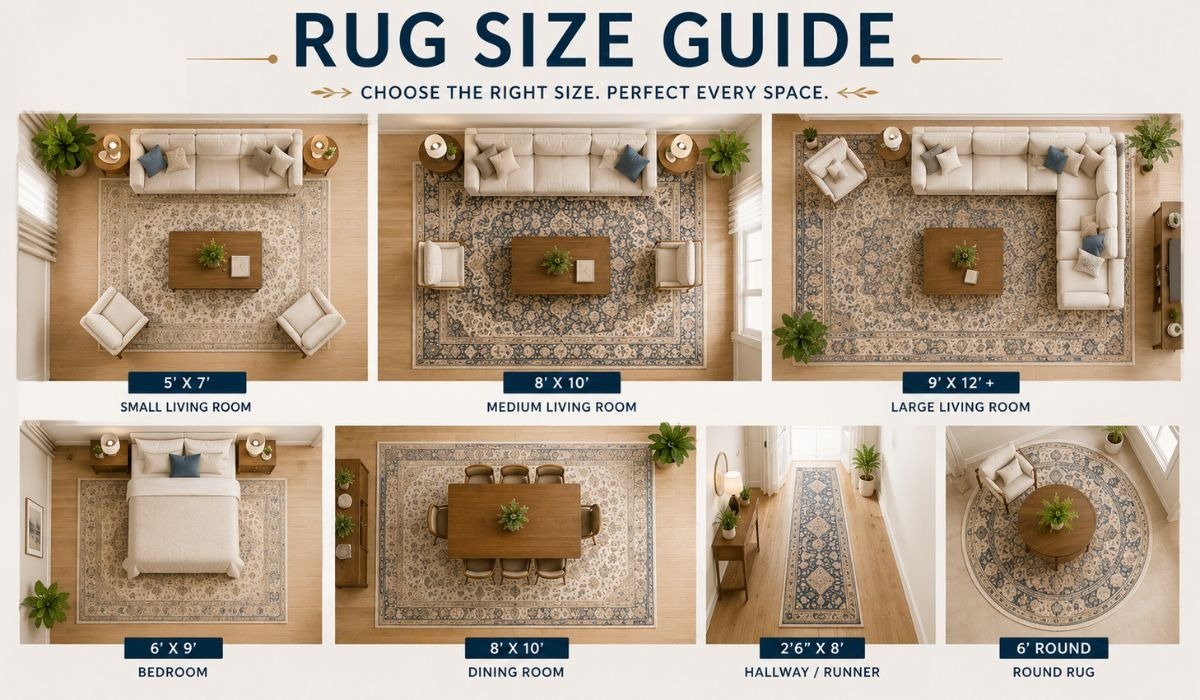
| Room | Recommended Starting Sizes |
| Living Room | 5×7, 6×9, 8×10, 9×12 |
| Dining Room | 6×9, 8×10, 9×12 |
| King Bedroom | 8×10, 9×12+ |
| Queen Bedroom | 6×9, 8×10 |
| Entryway | 2×3, 3×5 |
| Hallway | 2×6, 2×8, 3×8+ |
| Kitchen | 2×5, 2×6, 2×8 |
| Large Open Space | 9×12, 10×14+ |
Treat this table as a starting point for your search, not a strict rule — always confirm the fit against your own room’s measurements and furniture layout.
When Should You Choose a Custom Size Rug?
Standard rug dimensions don’t always fit every room. You may want to consider custom size area rugs if you have:
- An unusually shaped or irregular room layout
- An oversized room where even a 10×14 rug leaves too much bare floor
- A narrow space that doesn’t match standard runner dimensions
- A curved or angled furniture arrangement
- An open-plan interior with zones that don’t align with standard rug proportions
- A specific designer layout with exact dimension requirements
Custom made rugs and custom size carpet let you match the rug precisely to your room instead of compromising with the closest standard size. Once you’ve measured your space and know the dimensions that work, explore handcrafted area rugs from Agra Rugs & Handicraft to find a size and style suited to your room.
How Rug Material Can Affect Your Size Choice
Size isn’t the only decision that matters — material and construction influence how a rug performs at a given size. Wool rugs, jute rugs, cotton rugs, hand-knotted rugs, and hand-tufted rugs each behave differently underfoot and wear differently over time.
A few practical considerations:
- Durability — wool and hand-knotted rugs tend to hold up well in larger, high-traffic areas like living rooms.
- Pile height — a taller pile can make furniture clearance and door swing tighter, which matters when a rug is sized close to the room’s furniture footprint.
- Furniture clearance — thicker rugs may require slightly more room for chairs and doors to move freely.
- Cleaning — natural fiber rugs like jute and wool vary in how easily they’re cleaned, which is worth factoring in for larger rugs in high-traffic zones.
- Traffic — busier rooms often do better with more durable materials, regardless of the rug’s size.
Agra Rugs & Handicraft offers handcrafted wool area rugs and natural jute rugs, both worth considering once you’ve settled on the right dimensions for your room.
Common Rug-Sizing Mistakes to Avoid
- Choosing a rug that’s too small — a rug that doesn’t reach your furniture can make a room look disconnected.
- Ignoring furniture placement — always measure around your actual furniture layout, not just the room’s total size.
- Forgetting chair movement around dining tables — leave enough rug beyond the table edge for chairs to be pulled out.
- Blocking doors — check that doors can still swing open fully once the rug is in place.
- Ignoring room proportions — a long, narrow room may need a different shape than a square room of the same area.
- Buying before measuring — always measure and tape out the footprint first.
- Choosing based only on visual appearance — a rug that looks right in a photo may not be sized correctly for your specific room.
- Using the same rug size in every room — each room’s furniture and layout calls for its own sizing decision.
Frequently Asked Questions About Standard Rug Sizes
What are the most common rug sizes?
The most common standard rug sizes are 5×7, 6×9, 8×10, and 9×12, which cover the majority of living room, bedroom, and dining room layouts.
What is the most popular area rug size?
8×10 is generally considered the most popular area rug size, since it fits a wide range of medium to large rooms without overwhelming the space.
Is an 8×10 rug big enough for a living room?
Yes, for small to medium living rooms an 8×10 rug is usually big enough to anchor the seating area, though larger living rooms may need a 9×12 or bigger.
Is a 9×12 rug too big for a living room?
Not typically — a 9×12 rug fits well in larger living rooms and can actually look more proportionate than an 8×10 in a spacious room.
What size rug should go under a king bed?
An 8×10 or 9×12 rug is a common choice under a king bed, allowing the rug to extend on both sides and at the foot of the bed.
What size rug should go under a queen bed?
A 6×9 or 8×10 rug typically works well under a queen bed, depending on the room’s overall size.
What size rug is best for a dining table?
The best dining room rug extends 24 to 30 inches beyond the table’s edge on all sides, so chairs stay on the rug when pulled out.
What are standard runner rug sizes?
Standard runner rug sizes include 2×5, 2×6, 2×8, and 3×8, with longer custom runners available for extended hallways.
What size rug works best in a hallway?
Hallway rug size depends on the hallway’s width and length, but 2×6 and 2×8 runners are common starting points.
Are custom size rugs worth considering?
Yes, for irregular rooms, oversized spaces, or specific furniture layouts, a custom size rug can fit far better than the closest standard dimension.
Final Thoughts
The best rug size ultimately depends on your room’s dimensions, your furniture arrangement, foot traffic, the rug’s shape, how you plan to use the room, and the overall visual balance you’re aiming for. Standard rug sizes give you a strong starting point, but measuring your own space — and taping out the footprint before you buy — is what turns a good guess into a rug that genuinely fits.
Once you know the dimensions that work for your space, explore handcrafted area rugs in wool, jute, and other natural fibers from Agra Rugs & Handicraft to find a style that fits both your room and your lifestyle.